The Vibeary — tag
procgen
10 resources in The Vibeary tagged "procgen" — tools, libraries and references pulled from across the library's shelves, each one checked by hand before it was added.
Gems in this collection

MarkovJunior
Probabilistic programming language for generative art and level design based on rewrite rules and constraint propagation.
simplex-noise.js
Fast simplex noise implementation in TypeScript with seedable PRNGs and 2D, 3D and 4D variants.
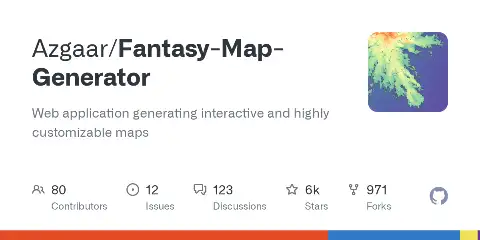
Fantasy Map Generator
Browser application generating interactive fantasy world maps with heightmaps, cultures, states, religions and exportable data.
shan-shui-inf
Procedurally generated infinite Chinese landscape painting rendered as scrolling SVG in the browser.

THREE.Terrain
Procedural terrain generation engine for three.js with multiple heightmap algorithms, erosion, scattering and texture blending.

ndwfc
N-dimensional wave function collapse with an infinite, lazily-expanded canvas rather than a fixed output grid.

rot.js
Roguelike toolkit for JavaScript with map generators, field of view, pathfinding, scheduling, RNG and display abstraction.
wavefunctioncollapse (JS)
JavaScript port of the WFC overlapping and simple-tiled models, usable directly in browser procgen pipelines.
graph-dungeon-generator
Graph-based procedural dungeon generator in TypeScript that places rooms from a connectivity graph with a readable implementation.
WaveFunctionCollapse
Original bitmap and tilemap generator that synthesises new outputs locally similar to a single example input.