The Vibeary — round-up
Best web game engines
Browser games have quietly become viable again: WebGL and WebGPU are fast, distribution is a URL, and the tooling has matured. The right engine depends entirely on scope. Jam-sized 2D games want something you can learn in an evening; a commercial project wants an editor, asset pipeline and physics; and a 3D game on the web means committing to a renderer early. This shelf splits the field so you can pick by scope, plus the netcode libraries you will need the moment two people play at once.
What earned a place
- Ships games, not just demos
- Asset pipeline and build size suited to the web
- Input, audio and physics either included or well-integrated
- Documentation and community large enough to unblock you
24 picks from the library
- 01
Bitty Engine
Itty-bitty 2D engine with built-in code, sprite, map and font editors, programmable in Lua and exportable to HTML5.
Why it made the list: All-in-one editor plus engine from a solo dev with a whole fantasy-console back catalog
Web game enginesopen-sourceTony Wang (@paladin-t)github.com
- 02
Colyseus
Node.js multiplayer framework with authoritative rooms, automatic binary state synchronisation, matchmaking and client SDKs for many engines.
Why it made the list: State sync is automatic and binary — you write game logic, not diffing code
Multiplayer & netcodeMITEndel Dreyer (@endel)colyseus.io

- 03
detect-gpu
Classifies a visitor's GPU from a benchmark database so you can pick shader quality tiers before rendering anything.
Why it made the list: Lets you ship heavy effects safely by degrading before the first dropped frame
PixiJS ecosystemMITPoimandres (@pmndrs)github.com
- 04
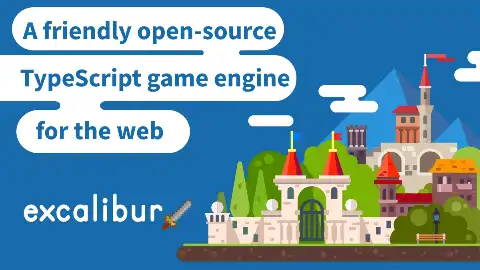
Excalibur.js
TypeScript-first 2D web game engine with actors, scenes, tilemaps, sound and a documented API aimed at web developers.
Why it made the list: Types-first design means autocomplete carries you; rare in the JS game engine space
Web game enginesopen-sourceExcalibur.js Projectexcaliburjs.com
- 05
geckos.io
Real-time client/server communication over UDP using WebRTC data channels and Node.js, built for fast-paced browser games.
Why it made the list: Actual UDP in a browser — removes the head-of-line blocking WebSockets impose
Multiplayer & netcodeopen-sourceYannick Deubel (@yandeu)github.com

- 06
Inkwave
Splatoon-style 4v4 turf-war shooter for the browser on three.js, with no build step and a live playable demo.
Why it made the list: No-build browser turf war that actually feels juicy to play.
Web game enginesMITjaydendavisncgithub.com
- 07
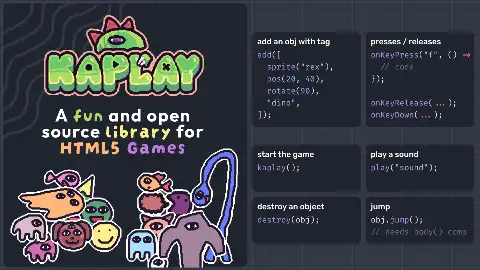
KAPLAY
JavaScript/TypeScript game library with a component-based API for sprites, collisions, physics and scenes; successor to Kaboom.js.
Why it made the list: Kaboom's playful API kept alive and maintained after the original was abandoned
Web game enginesopen-sourceKAPLAY community (@lajbel, @slmjkdbtl)kaplayjs.com
- 08
litecanvas
Roughly 4kb HTML5 canvas engine with a tiny global API for jams, prototypes and size-limited game competitions.
Why it made the list: Fits in a tweet-sized mental model; ideal for one-sitting game prototypes
Web game enginesMIT(@litecanvas)github.com
- 09
LittleJS
Zero-dependency 2D HTML5 engine with WebGL batch renderer, built-in particle system, audio and physics in a tiny bundle.
Why it made the list: Js13k-grade size discipline with full-fat engine features; particles and juice built in
Web game enginesMITFrank Force (@KilledByAPixel)github.com
- 10
melonJS
Lightweight HTML5 game engine with Tiled map support, entity pooling and WebGL/canvas fallback rendering.
Why it made the list: Fifteen-year-old engine still shipping releases; best-in-class Tiled map integration
Web game enginesMITmelonJS teamgithub.com
- 11
microStudio
Browser-based game engine and IDE with built-in sprite editor, map editor and its own scripting language, plus multiplayer.
Why it made the list: Whole toolchain in a browser tab: code, sprites, maps, publish — no install
Web game enginesopen-sourcePierre Gaufillet (@pmgl)github.com
- 12
netplayjs
Peer-to-peer browser multiplayer with rollback netcode and no server hosting or synchronisation code required.
Why it made the list: Rollback netcode — the fighting-game gold standard — as a drop-in JS library
Multiplayer & netcodeMITVarun Ramesh (@rameshvarun)github.com

- 13
noa
Experimental voxel engine for the browser handling chunked terrain, meshing and voxel physics on top of Babylon.js.
Why it made the list: Ready-made voxel plumbing so you skip six months of chunk-meshing work
Web game enginesMITAndy Hall (@fenomas)github.com

- 14
p5play
Game engine layering sprites, animation, groups and Box2D physics on top of p5.js/q5.js for creative coders.
Why it made the list: Bridges the creative-coding crowd into real physics-driven game mechanics
Web game enginesopen-sourceQuinton Ashley (@quinton-ashley)github.com

- 15
pixi-ease
Easing and tweening library for PixiJS display objects with chaining, repeat, reverse and a shared ticker.
Why it made the list: Purpose-built for Pixi objects so you skip the generic-tween adapter layer
PixiJS ecosystemMITDavid Figatner (@davidfig)github.com
- 16
pixi-live2d-display
PixiJS plugin that renders Live2D Cubism models, handling motions, expressions, hit areas and lip sync.
Why it made the list: The practical route to animated VTuber-style characters in a plain web page
PixiJS ecosystemMIT(@guansss)github.com

- 17
pixi-tilemap
Rectangular tilemap renderer for PixiJS that batches thousands of tiles into few draw calls for large scrolling levels.
Why it made the list: Solves the naive-sprite-per-tile trap that kills framerate on big maps
PixiJS ecosystemMITPixiJS userlandgithub.com

- 18
Pixi3D
3D renderer built on PixiJS with glTF loading, PBR materials and shadows that composes with existing 2D scenes.
Why it made the list: Adds glTF 3D to a 2D Pixi game without swapping renderers or engines
PixiJS ecosystemMITJens Malmborg (@jnsmalm)github.com

- 19
PixiJS Filters
Community collection of display filters for PixiJS: glow, godray, CRT, bulge-pinch, shockwave, ascii, dot screen and more.
Why it made the list: Instant screen-effect vocabulary — CRT, shockwave, glitch — as one-line filters
PixiJS ecosystemMITPixiJS teamgithub.com

- 20
PixiJS Particle Emitter
Configurable particle system for PixiJS with an accompanying visual editor for authoring emitter presets.
Why it made the list: The visual emitter editor turns particle tuning from code guesswork into direct manipulation
PixiJS ecosystemMITPixiJS userlandgithub.com

- 21
Playroom Kit
Hosted real-time multiplayer backend with lobbies, state sync, phone-as-controller and streaming-friendly modes for web and Unity games.
Why it made the list: Phones-as-gamepads and instant lobbies remove the hardest part of party games
Multiplayer & netcodefreemiumPlayroomjoinplayroom.com

- 22
quadplay
Fantasy console with a browser IDE, 16-colour-ish constraints and a scripting language tuned for fast game jams.
Why it made the list: Built by a graphics researcher; constraints tuned for finishing rather than tinkering
Web game enginesopen-sourceMorgan McGuire (@morgan3d)github.com

- 23
Sprig
Hack Club's browser game editor and tiny engine designed for teaching programming through building playable games.
Why it made the list: Teen-tested learning ramp; the editor ships a real hardware handheld target
Web game enginesMITHack Club (@hackclub)github.com
- 24
THNK
Authoritative multiplayer framework adding server-side simulation, prediction and lag compensation to browser-exportable games.
Why it made the list: Brings authoritative-server architecture to a no-code engine crowd
Multiplayer & netcodeMITArthur Pacaud (@arthuro555)github.com

Questions
- What is the easiest web game engine to start with?
- A small 2D framework with a single-file API. You will learn the game loop without fighting an editor.
- Can browser games handle multiplayer?
- Yes — WebSocket and WebRTC netcode libraries on this shelf handle rooms, state sync and rollback.