The Vibeary — round-up
Best colour palette tools and references
Most colour problems are not solved by another palette generator — they are solved by understanding shade ramps, contrast and perceptual lightness. So this list mixes both: the generators and scale builders you will use on a Tuesday afternoon, and the small number of articles that genuinely change how you choose colour. Between them you can build an accessible ramp from a single brand hue, sanity-check contrast against WCAG, find colour-blind-safe qualitative palettes for charts, and stop reaching for lighten() and darken() functions that quietly destroy saturation.
What earned a place
- Produces a usable ramp or system, not one pretty five-swatch card
- Takes accessibility and contrast seriously
- Free to use, with values you can export as tokens
- Reference material is written by practitioners who ship
24 picks from the library
- 01
Accessible Color Systems
Stripe engineering post on building a colour system that guarantees contrast ratios while preserving brand hue relationships.
Why it made the list: Production account of solving contrast at scale from a team known for craft
Color theoryfreeStripe design teamstripe.com
- 02
apcach
JavaScript library that generates colors from a target APCA contrast value instead of picking a color and checking after.
Why it made the list: Inverts the contrast workflow: declare the contrast, get the color. Rare idea.
ColorMITEvil Martiansevilmartians.com

- 03
Atmos Playground
Color system builder that generates full tonal scales from a few seeds and checks WCAG and APCA across every pairing.
Why it made the list: Treats color as a system with a contrast grid, not a pretty five-swatch strip.
ColorfreemiumAtmosatmos.style
- 04
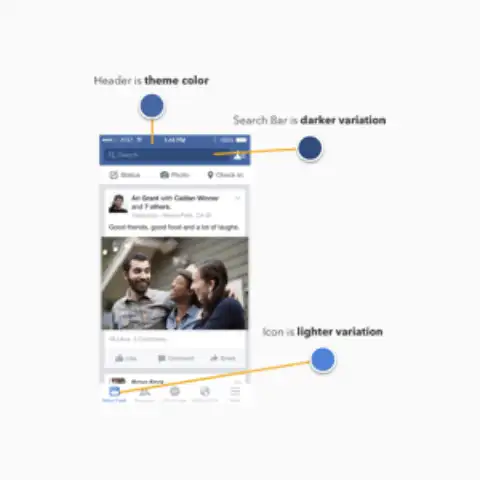
Color in UI Design: A Practical Framework
Framework for choosing and applying UI colour: neutrals, one accent, saturation ranges and when to break the rules.
Why it made the list: Actionable constraints rather than colour-wheel theory; works immediately in Figma
Color theoryfreeErik Kennedy (@erikdkennedy)learnui.design
- 05
Colorable
Minimal matrix that cross-checks every color in a palette against every other for WCAG contrast in one glance.
Why it made the list: The whole-palette contrast grid in one screen, from a design-systems veteran.
ColorMITBrent Jackson (@jxnblk)colorable.jxnblk.com
- 06
ColorBox
Lyft's tool for generating color ramps by curve-editing hue, saturation and luminosity independently across the scale.
Why it made the list: Curve-based scale authoring from a real design team; still unmatched for control.
ColorfreeLyft Designcolorbox.io
- 07
Colorfetti
Browser palette-recoloring tool for images, sprites and animated GIFs, with auto palettes, curated presets, imported palette files and 1-bit two-colour styles.
Why it made the list: Recolors whole animated GIFs and sprite sheets to a palette, entirely on device.
Colorfree@Shiloshilo.github.io

- 08
colorgrad-js
Rust-and-WebAssembly colour gradient library exposing scientific colormaps and custom gradient construction to JavaScript.
Why it made the list: Viridis, cividis and friends in JS at wasm speed
Colour scalesMITNor Khasyatillah (@mazznoer)github.com
- 09
colormap-shaders
GLSL shader implementations of over 100 named colormaps for use in WebGL and GPU visualisations.
Why it made the list: Colormaps as shader functions — no lookup texture, no CPU round trip
Colour scalesMITkbinani (@kbinani)github.com
- 10
Colormason
Agent skill that turns one brand hex into OKLCH ramps, WCAG-checked semantic tokens, and Tailwind or CSS output offline.
Why it made the list: Deterministic, zero-dependency palette builder agents can run without APIs.
ColorMIT@vladzimagithub.com
- 11
Colors.lol
Curated overly descriptive color palettes with names and hex codes, built as a design-inspiration source rather than a generator.
Why it made the list: Personality-driven curation; a palette source that doesn't feel algorithmically generic.
ColorfreeAdam Fuhrer (@adamfuhrer)colors.lol
- 12
Colourco.de
Pick colors by dragging across a hue field and instantly get monochromatic, analogic and triadic sets with lightness control.
Why it made the list: Direct-manipulation color picking that feels like a physical instrument.
ColorfreeToni Wagnercolourco.de
- 13
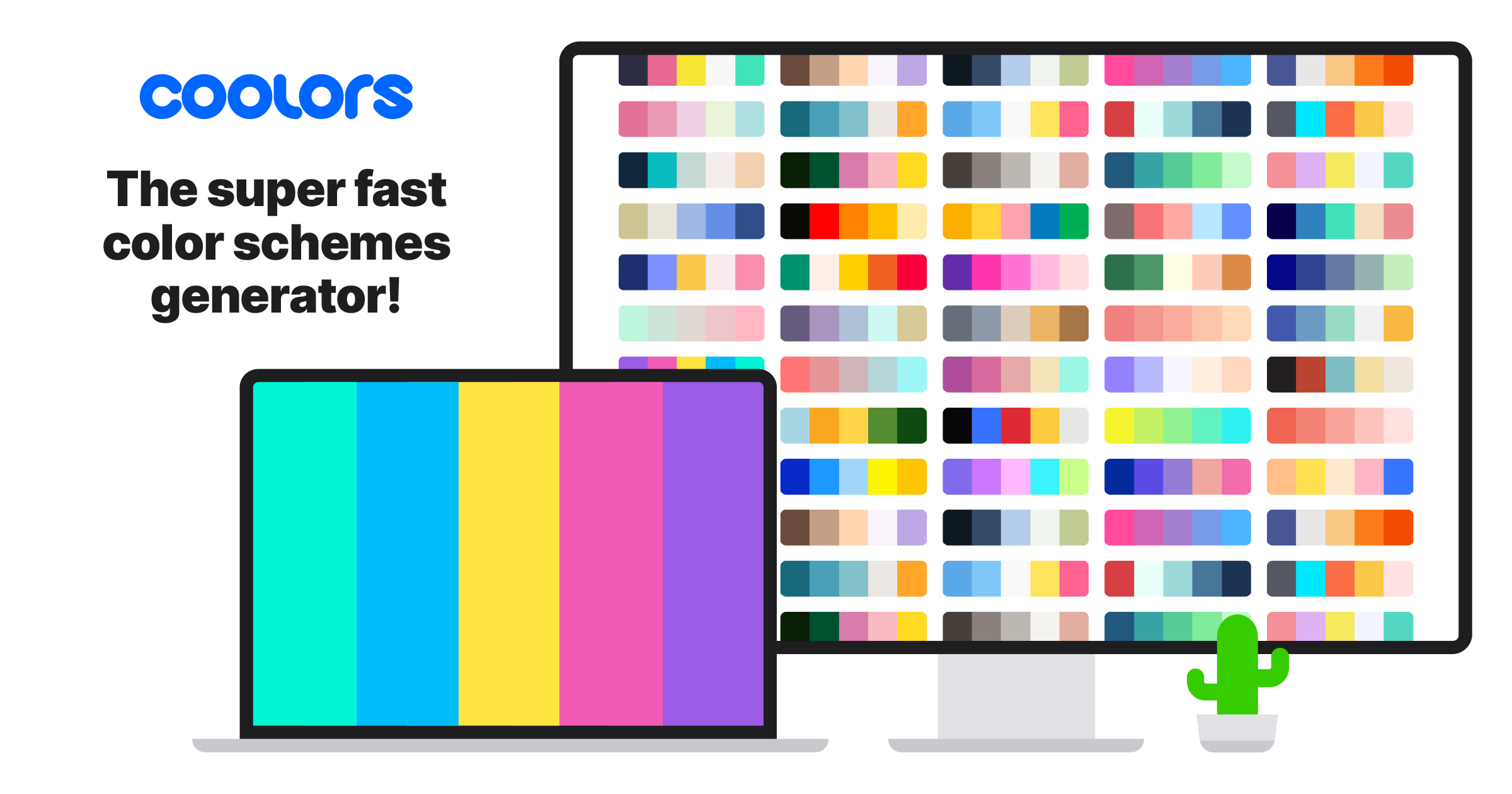
Coolors
Spacebar-driven palette generator with 10M+ browsable palettes, image colour extraction, contrast checking, gradient tools and palette mockup previews.
Why it made the list: Fifteen years of solo maintenance and still the fastest palette loop on the web.
ColorfreemiumFabrizio Bianchi (@fabrizio_bianchi)coolors.co
- 14
css.gui
Visual, parametric CSS editing environment that treats every CSS property as an editable, themeable design parameter.
Why it made the list: Parametric approach to CSS that nothing else has replicated since.
Theming & colorMITComponents AI (@components-ai)github.com
- 15
Data Color Picker
Generates sequential and diverging palettes for charts, interpolating in a perceptual space so steps read as even.
Why it made the list: Chart palettes done right; most designers hand-pick these badly and never notice.
ColorfreeErik Kennedylearnui.design
- 16
Desktop Colors
Archive of every solid desktop background colour shipped by classic operating systems: 194 colours across 22 platforms, 1985 to 2024.
Why it made the list: Obsessive colour archaeology; a real reference palette nobody else has assembled.
Colorfreevlowdesktopcolors.com
- 17
Duo
Two-color pairing tool that shows every combination rendered as real UI so you can judge legibility, not swatches.
Why it made the list: Single-purpose, single-dev, and better at its one job than any big suite.
ColorfreeAlex Pateduo.alexpate.com

- 18
Ember
Terminal, chart, heatmap and UI palettes engineered to stay distinguishable after aggressive Redshift or Night Shift warm-screen filtering.
Why it made the list: Solves a colour problem nobody designs for: palettes that survive night-mode filters.
ColorMITcarpdiemgithub.com
- 19
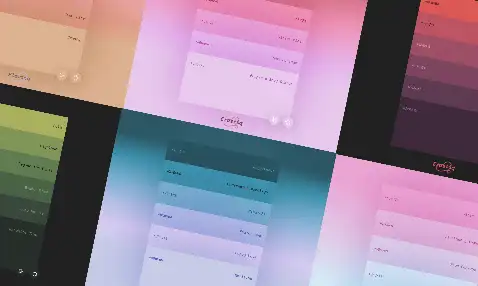
FarbVelo
Generative random-color explorer with perceptual distance controls, color-blindness preview and a genuinely playful interface.
Why it made the list: The most fun-to-use color toy on the web and quietly rigorous underneath.
ColorfreeDavid Aerne (@meodai)farbvelo.elastiq.ch
- 20
Firelight
Interface and code colour palette with Coal, Smoulder and Ash variants, contrast-checked tokens, CSS variables and OKLCH values.
Why it made the list: Warm fire-inspired palette with accessible fg/bg pairs for UI and terminals.
ColorMIT@ridusainigithub.com
- 21
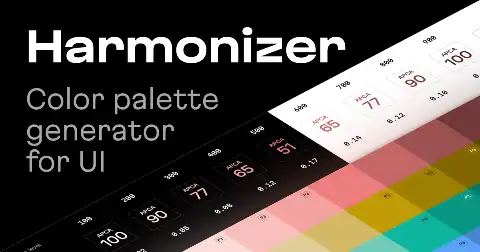
Harmonizer
Evil Martians generator that produces color scales with matched perceptual contrast across hues using OKLCH and APCA math.
Why it made the list: Solves the 'yellow looks wrong at step 500' problem almost nobody else solves.
ColorfreeEvil Martiansharmonizer.evilmartians.com
- 22
How to pick the least wrong colors
Long essay deriving an algorithm for generating accessible, perceptually even colour palettes, with interactive demos.
Why it made the list: Rare piece that combines perceptual colour science with shipping design-system constraints
Color theoryfreeMatthew Ström (@ilikescience)matthewstrom.com
- 23
Hueclid
Extracts an accessible UI palette from any screenshot or photo using CIELAB clustering and Oklch gamut mapping.
Why it made the list: Returns coverage-weighted screen colors with contrast in mind, not five random swatches.
ColorMITGaurav Raj Singh (@suvoisreal)hueclid.portways.app

- 24
Huemint
Uses a machine-learning model trained on real designs to generate palettes constrained to a chosen layout or brand context.
Why it made the list: Generates palettes for a specific layout, so output is usable not just pretty.
ColorfreeJack Qiaohuemint.com

Questions
- How many shades should a UI colour ramp have?
- Nine to eleven steps per hue covers almost every interface need: backgrounds, borders, text and states. Define them once as tokens rather than deriving them per component.
- What is the best colour space for UI palettes?
- OKLCH, where your tooling supports it. It keeps perceived lightness consistent across hues, which is exactly what a ramp needs.